

In this article
In short
- 01The default in treatment is permissibility, except what the Lawgiver forbade.
- 02None of the eight below is a method to try; all of it is what to recognise and refuse.
- 03If anyone offering “ruqyah” produces wires, electricity, beating, choking or anything that hurts the body, leave and report them.
- 04The haram is a disease, not a cure. Allah has placed healing in His words, in du‘ā, and in lawful medicine.
The Prophet ﷺ said: “Seek treatment, servants of Allah — but do not treat with the haram.” The default in treatment is permissibility, except what the Lawgiver forbade. Eight things have spread in our times which people imagine to be treatments, when in truth they are among the forbidden and the harmful, things that only add weakness upon weakness. None of what follows is a method to try; all of it is what to recognise and refuse.
- 1Amuletstama’im — hung in the belief they repel evil and attract good
- 2Collecting soil from the place where you fell illIn its reality a kind of appeasement of the jinn
- 3Going to sorcerers, fortune-tellers and soothsayersGoing to them is the disease itself
- 4Music therapyWhat is forbidden cannot be a path to health
- 5Electric wires used by some recitersTormenting the body with fire, and it can kill
- 6Treating with alcohol“It is not a medicine — it is a disease”
- 7Medicines containing pork fat or unlawful animal partsTaking them means consuming the unlawful substance
- 8Drinking the blood of animals or birdsHaram by the Book, the Sunnah, and reason
1. Amulets (tama’im)
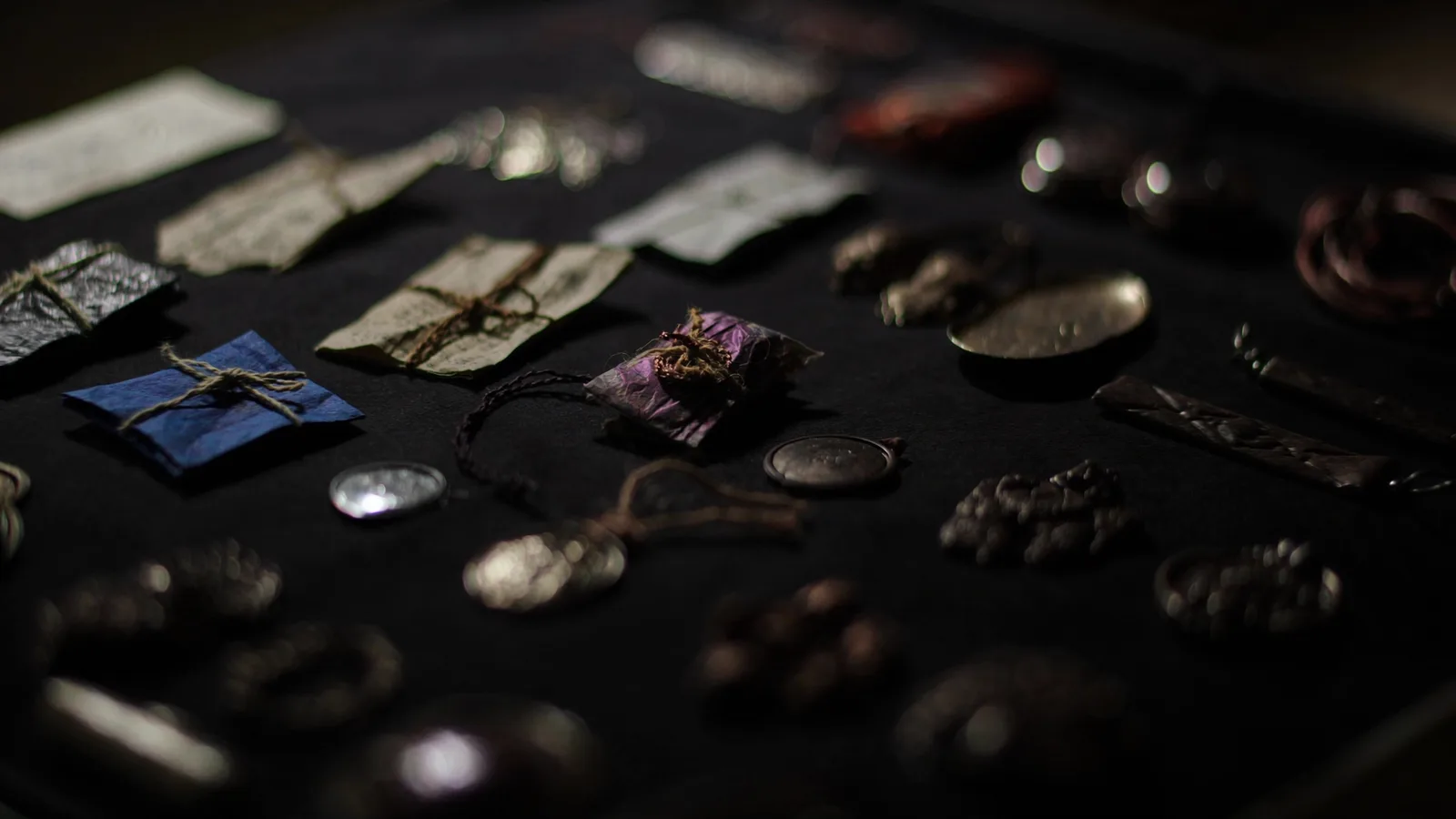
Cowrie shells, threads, written papers and the like, hung on the body in the belief that they repel evil and attract good. Some herbal healers sell these “hijabs” or “charms” at steep prices; many are covered in talismans and unintelligible writing, and many are outright invocations of the jinn and the chief devils. They are forbidden treatment.
The proofs:
- Allah says, “Say: have you considered what you call upon besides Allah — if Allah intended me harm, could they remove His harm? Or if He intended me mercy, could they withhold His mercy? Say: sufficient for me is Allah; upon Him rely the reliant” (al-Zumar 39:38).
- The Prophet ﷺ, on a journey, sent a messenger ordering that “no necklace of bowstring — or any necklace — remain on a camel’s neck but it is cut off” (Bukhari and Muslim).
- He saw a man wearing a brass ring and asked, “What is this?” The man said: it is for al-wahinah (weakness of the arm). He said: “Remove it, for it will only increase you in weakness — and if you died wearing it, you would never succeed” (Ahmad, Ibn Hibban, al-Hakim).
- And he ﷺ said: “Whoever hangs an amulet, may Allah not complete his affair; and whoever hangs a cowrie, may Allah give him no rest”, and in one narration: “Whoever hangs an amulet has committed shirk” (Ahmad; al-Hakim).
- Ibn Mas‘ud heard him say: “Incantations (of shirk), amulets and love-charms are shirk” (Ahmad, Abu Dawud, Ibn Majah, Ibn Hibban, al-Hakim).
- And: “Whoever attaches himself to a thing is left to it” (Ahmad, al-Tirmidhi).
- And in the hadith of Ruwayfi‘: “O Ruwayfi‘, perhaps life will stretch long with you — so tell the people that whoever knots his beard, or wears a bowstring necklace, or cleans himself with animal dung or bone — Muhammad is free of him” (Ahmad).
So amulets are all forbidden: the shirk kind by consensus, and even amulets made of Quran on the sounder view, because the prohibiting texts are general and are not restricted without evidence; to close the door that leads hearts to attach to other than Allah; to protect the Quran from being carried into disrespect; and to shut the route by which shirk amulets spread. This is the position of most of the later scholars. Do not be taken in by the false stories and invented tales that the peddlers of religion circulate about the power of these charms.
2. Collecting soil from the place where you fell ill
Some sick people, having fallen somewhere and become unwell, go back to that spot to gather its soil, or to pour recited water over it, intending cure by it. This is not permitted: in its reality it is a kind of appeasement of the jinn, an act of drawing near to them and buying off their evil, with no evidence behind it: there is no visible connection between this act and healing any disease. It is guesswork, ignorance, and trailing after baseless tales.
It is not even a “treatment” about which we ask for evidence: establishing something as a treatment needs either a text or the testimony of trustworthy experts, and no expert testimony exists for this; most practitioners deny it, and some have never even heard of it. It is, in the source’s words, a devilish innovation with no root, no supporting evidence and no confirming experience, a thing the common people pass around in hope of a cure even at the price of their creed. The duty is to leave it, warn against it, and for those in authority to stop whoever teaches it.
3. Going to sorcerers, fortune-tellers and soothsayers
Forbidden by agreement of the scholars, a doorway of kufr and shirk, and in some of its forms major shirk that removes a person from Islam altogether. Going to them is the disease itself.
The Prophet ﷺ said: “Whoever goes to a fortune-teller and asks him about anything, no prayer is accepted from him for forty days” (Muslim 2230). And: “Whoever goes to a soothsayer and believes what he says has disbelieved in what was sent down upon Muhammad ﷺ” (authentic, related by the compilers of the Sunan). And: “He is not of us who reads omens or has them read for him, who soothsays or has it done for him, who works sihr or has it worked for him; and whoever goes to a soothsayer and believes what he says has disbelieved in what was sent down upon Muhammad ﷺ” (al-Bazzar, with a good chain). Mu‘awiyah ibn al-Hakam said: “O Messenger of Allah, there are things we used to do in Jahiliyyah — we used to go to soothsayers.” He said: “Do not go to soothsayers” (Muslim). And when people asked him about the soothsayers he said: “They are nothing.” They said: “O Messenger of Allah, sometimes they say a thing and it comes true.” He said: “That is the word of truth which the jinnī snatches and cackles into the ear of his familiar — and they mix into it more than a hundred lies” (Bukhari and Muslim).
The source is blunt: this foul trade deserves to be fought and reported to the authorities until it is uprooted, as it has uprooted the faith of so many. Guard your religion by cutting off every road to them, and warn other Muslims of them: they are the enemies of the religion, the darlings of Iblis and the executors of his schemes.
4. Music therapy
The source addresses the “music therapy” practised by some psychologists it describes as westernised: in their view music can treat certain psychological conditions. It rules this impermissible, because musical instruments are forbidden, and what is forbidden cannot be a path to health: “Allah did not place the cure of this Ummah in what He forbade upon it,” and “do not treat with the haram.” It cites the scholarly literature at length: al-Albani’s Tahrim Alat al-Tarb, Ibn al-Qayyim’s al-Kalam ‘ala Mas’alat al-Sama‘, and Ibn Taymiyyah’s al-Istiqamah.
Among the evidence it gathers:
- “There will be people of my Ummah who drink wine, calling it by another name, while instruments and singing-girls play over their heads — Allah will cause the earth to swallow them, and make of them apes and swine” (Ahmad, Ibn Majah, Ibn Hibban);
- “I was forbidden two foolish, sinful sounds: a sound at the time of amusement — the flutes of Shayṭān — and a sound at the time of calamity — striking of cheeks and tearing of garments” (Abu Dawud; al-Tirmidhi, who graded it hasan);
- “Two sounds are cursed in this world and the next: a flute at a blessing and a wail at a calamity” (al-Bazzar, good chain);
- “There will be among my Ummah people who declare lawful illicit relations, silk, wine and instruments” (Bukhari).
It adds the sayings of the salaf:
- al-Dahhak: “singing corrupts the heart and angers the Lord”;
- Ibn Mas‘ud: “singing sprouts hypocrisy in the heart as water sprouts crops”;
- Ibn al-Qayyim: “singing corrupts the heart, and when the heart is corrupted, hypocrisy stirs in it”;
- al-Fudayl ibn ‘Iyad: “singing is the incantation of zina”;
- the interpretation of “and among people is he who buys idle talk to mislead from the path of Allah” (Luqman 31:6) as singing, from a number of Companions;
- and Muhammad ibn al-Hanafiyyah reading “those who do not witness falsehood” (al-Furqan 25:72) as the singing-gathering.
It notes al-Qadi ‘Iyad’s report of consensus on the disbelief of one who declares singing lawful (as cited by Ibn Muflih), and al-Tabari’s report of the scholars’ agreement in censuring it.
The source closes the section with a du‘ā that Allah grant singers and listeners sincere repentance. Our note: whatever position your own scholars take on this much-debated question, the practical point stands: do not put your hope of healing in a soundtrack. Healing is in Allah’s words, du‘ā, and lawful medicine.
5. Electric wires used by some reciters
Some reciters (may Allah guide them) have used live electric wires on patients during treatment. It is forbidden and dangerous. The source gives two reasons:
- It is tormenting the body with fire, and the Prophet ﷺ said, “None punishes with fire except the Lord of fire.” Electricity in its reality is fire; indeed one who dies by electrical burning is counted among those for whom martyrdom is hoped, as one who dies by burning.
- The physical dangers are enormous: it can kill the patient, disable senses, paralyse limbs, disfigure the body. All of that is forbidden: Allah has honoured the human being, body and soul. The authorities have banned treatment by such methods, and obeying them in this is obligatory, for it is a command of good and a prevention of great harm.
Our note: if anyone offering “ruqyah” produces wires, electricity, beating, choking or anything that hurts the body, leave and report them. That is not ruqyah.
6. Treating with alcohol
Forbidden. Allah says: “O you who believe, wine, gambling, altar-stones and divining arrows are filth of Shayṭān’s work, so avoid it, that you may succeed” (al-Ma’idah 5:90). Tariq ibn Suwayd asked the Prophet ﷺ about wine and he forbade him; Tariq said, “I only make it as medicine.” He replied: “It is not a medicine — it is a disease” (Muslim 1984).
7. Medicines containing pork fat or unlawful animal parts
The source rules that medicines whose composition includes pig fat, or parts of animals unlawful to eat, are forbidden to take, since taking them means consuming that unlawful substance: “Say: I do not find within what has been revealed to me anything forbidden to one who would eat it except carrion, spilled blood, or the flesh of swine — for it is filth — or a transgression dedicated to other than Allah” (al-An‘am 6:145).
Our note: many contemporary fatwa bodies permit medicines in which the substance has been chemically transformed, or where there is genuine medical need and no alternative. Do not stop prescribed medicine without speaking to your doctor and a knowledgeable scholar.
8. Drinking the blood of animals or birds
Some folk practice treats illnesses such as whooping cough by drinking animal blood, for example lizard’s blood. Sheikh Muhammad ibn Ibrahim (may Allah have mercy on him) was asked about it and answered at length: if the blood is spilled blood, it is haram, and treating with it is not permitted, by the Book, the Sunnah, and reason.
From the Book: “Forbidden to you are carrion and blood…” (al-Ma’idah 5:3), unrestricted; and “…except carrion, or spilled blood…” (al-An‘am 6:145), restricted, and the unrestricted is carried upon the restricted. The prohibition attaches to everything the substance is used for: drinking, treating, selling.
From the Sunnah:
- Ibn Mas‘ud: “Allah did not place your cure in what He forbade upon you” (Bukhari in ta‘liq form; connected by al-Tabarani with trustworthy narrators), a report whose meaning holds until the Day of Resurrection: since part of how medicine works is the patient receiving it with acceptance and trusting its benefit, while the believer’s heart loathes the forbidden substance, the haram taken as medicine cannot heal.
- The hadith of Tariq above: “It is not a medicine — it is a disease,” explicit about wine and extended to every haram by analogy.
- “The Messenger of Allah ﷺ forbade the filthy remedy” (the Sunan), and what is forbidden is forbidden for its foulness, and the foul contains no benefit and so no cure.
- Abu al-Darda’: “Allah sent down the disease and the remedy, and made for every disease a remedy — so seek treatment, but do not treat with the haram” (Abu Dawud; al-Tabarani with trustworthy narrators).
From reason, Sheikh Muhammad ibn Ibrahim’s six points, in brief:
- Allah forbade these things for their foulness, not, as with Banu Isra’il, as a punishment stripping away good things; so seeking health in them contradicts the very purpose of their prohibition. Whatever they might do for the body, they leave the heart with a worse sickness.
- Prohibition demands distance by every route, while prescribing a thing as medicine invites people towards it, a contradiction of the Lawgiver’s intent.
- The haram is a disease by the Lawgiver’s own designation, so it cannot be taken as a remedy.
- The nature of a medicine passes into the one who takes it: a foul substance imprints its foulness on the constitution and the spirit, which is why Allah forbade foul foods, drinks and dress.
- Allowing the haram as medicine opens the door to taking it for appetite and pleasure, especially once people believe it benefits them, while the Lawgiver’s way is to block every road to it.
- And in that forbidden “remedy” are diseases that outweigh whatever cure is imagined in it.
Conclusion of the fatwa: treating by drinking spilled blood is haram and its doer is sinning, and no one’s opinion stands against the Book, the Sunnah and sound reasoning.
The thread running through all eight
Every one of these is someone selling a shortcut: hang this, drink this, plug into this, visit this man — and be cured. The Sharī‘ah’s answer: the haram is a disease, not a cure. Allah has placed healing in His words, in du‘ā, and in lawful medicine, and He has not placed the cure of this Ummah in what He forbade it.
Medical first, alongside ruqyah — nothing here replaces a doctor’s care.
Sources
- Hadith collections: Bukhari, Muslim 1984 & 2230, Ahmad, Abu Dawud, al-Tirmidhi, al-Bazzar, al-Hakim
- Fatwa of Sheikh Muhammad ibn Ibrahim on treating with blood
- al-Albani, Tahrim Alat al-Tarb; Ibn al-Qayyim; Ibn Taymiyyah, al-Istiqamah — on the music question
- Classical and practitioner sources — see Methodology → Our sources

Who damages ruqyah's good name — a candid list from inside the practice
An experienced raqi's defence of ruqyah against its critics, written from inside decades of practice.
Read