
In this article
In short
- 01Things bought to protect from the eye achieve nothing against it, and the reliance placed on them wounds a person’s tawḥīd.
- 02An object that carries Quran is still an amulet: the problem is the hanging and the reliance.
- 03The same rule decides the knife under the pillow and the salt in the corners — is this something Allah appointed as a cause, or something we appointed?
- 04A house with nothing hanging in it is protected by what its people say.
Alongside the forbidden ‘treatments’ there is a whole family of objects (worn, hung or carried) that people believe repel the eye and ḥasad. These beliefs are mistaken and lead towards shirk, and Allah’s refuge is sought. Things bought to protect from the eye achieve nothing against it, and the reliance placed on them wounds a person’s tawḥīd.
The list: recognise these and leave them
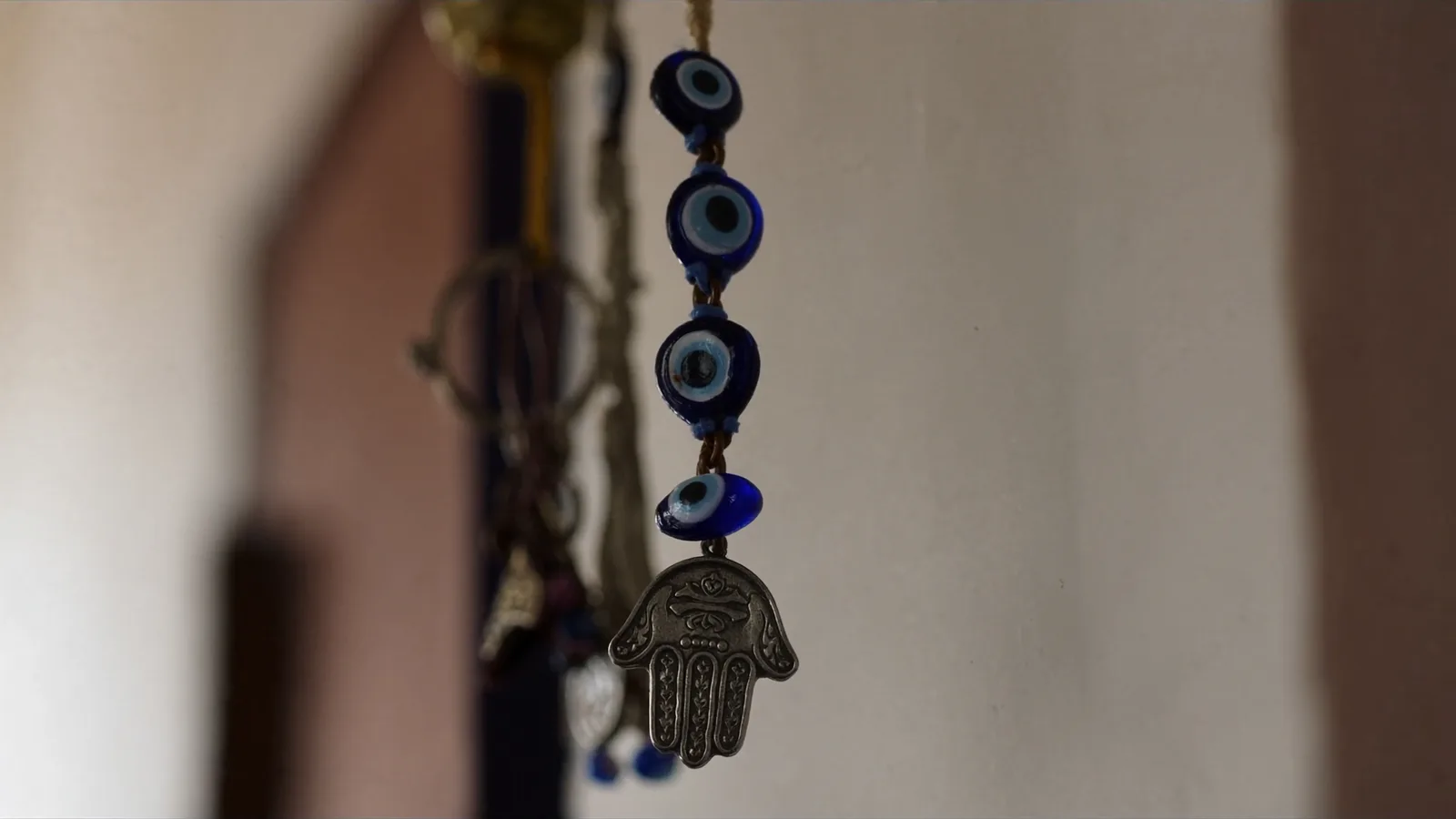
- 1The blue “evil eye” bead (nazar)The blue-and-white glass eye seen everywhere in the West — on bracelets, keyrings, doorways, baby prams and phone cases, often sold as “evil eye protection”. It is not named in the source’s list, which predates its Western fashion, but it is the very same category: a created object trusted to repel harm. It repels nothing.
- 2Protective necklaces and braceletsLong customary among girls and women and now fashionable among young men too, worn with the intention of repelling the eye and ḥasad.
- 3The hamsa hand (khamsa wa khumaysa)The hand-shaped charm, sometimes even inscribed with Quranic verses to mislead people. Fatwas state it is not permissible to hang it even when it carries Quran: the problem is the hanging and the reliance, which no verse on the surface can fix.
- 4Aqeeq stones and ringsBelieved to repel the eye. A stone is a stone; it neither benefits nor harms by itself.
- 5Giving children ugly namesIn the belief that an unattractive name will keep the eye away from them.
- 6Strings and threadsBrought from sorcerers or collected from shrines and tied on the body.
- 7Animal charmsBeliefs attached to the hippopotamus, or hanging a hoopoe’s head, and the like.
- 8Gold and silver Quran-verse pendants on children’s chestsBesides the false reliance, the source notes a further wrong: it is a slight against the Book of Allah, because the child understands neither the meaning nor the worth of the verses hung on him.
- 9Amulet sachets of black seed, alum, salt or beansLittle bags believed to protect a person or a place. The trick: black seed and salt are used in permitted remedies (eaten, drunk, washed with), but sew them into a pouch and hang them up, and they have become an amulet like any other. The benefit was never in carrying; it was in using, with reliance on Allah.
What the Sunnah gives instead
The Sunnah’s protections (the morning and evening adhkār, al-Falaq and al-Nās, Āyat al-Kursī, du‘ā, charity, saying “bārak Allāh”) cost nothing, need no shop, and work by the permission of the One who controls harm and benefit. Everything on the list above substitutes a trinket for that connection. If you own any of them, you lose nothing by removing them, and you recover something valuable: a tawḥīd with nothing hanging off it.
And what people put in the corners of the room
The list above is what people wear. There is a second set nobody thinks of as religious at all, kept by households who would never hang an amulet.
A knife under the pillow. Iron at the threshold. Salt thrown into the corners, or dissolved and sprinkled at the door. A blue bead over a cot. A horseshoe. A hand.
The same rule decides all of them: is this something Allah appointed as a cause, or something we appointed? Where He made a thing a means of protection, using it is taking the means. Where we decided it was, we have taken as a cause what is not a cause.
This catches the sincere. Almost nobody putting a knife under a pillow believes the knife has power; they believe Allah protects and that this is a means. The difficulty is there, because appointing means is not ours to do.
Iron and knives are usually justified by something half-remembered about the jinn and metal; there is no established basis for placing iron as protection, and the protections that are established are all things a person says. Salt is sprinkled at doors and corners, sometimes with recitation over it: recited water is established, salt is not, and adding it makes a household custom wear religious clothes.
What protects a house
Sūrat al-Baqarah recited in the home, which the Sunnah connects to the house specifically. The morning and evening adhkār, kept by the people who live there. The du‘ā on entering and leaving. Saying the barakah du‘ā aloud when you admire what is in your house, the half of prevention almost nobody practises. And nothing hanging anywhere.
A house with nothing hanging in it is protected by what its people say.
If a relative put one there, take it down quietly and do the things above instead. You do not owe anybody an argument about it, and somebody who put a bead over a cot did it out of love, which is worth remembering while you remove it.
Medical first, alongside ruqyah — nothing here replaces a doctor’s care.
Sources
- Classical and practitioner sources — see Methodology → Our sources
What makes a treatment forbidden? One rule to keep
Before listing forbidden “cures” one by one, learn the single rule they all fall under; once you hold it you can judge any new remedy you meet, including ones no scholar has yet been…
Read